
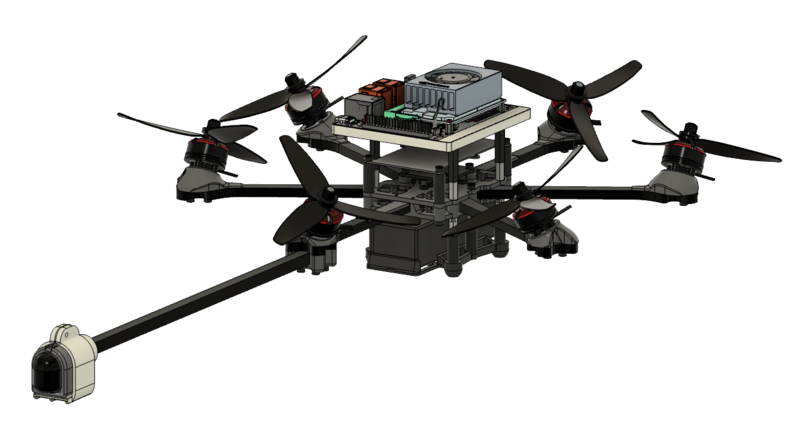
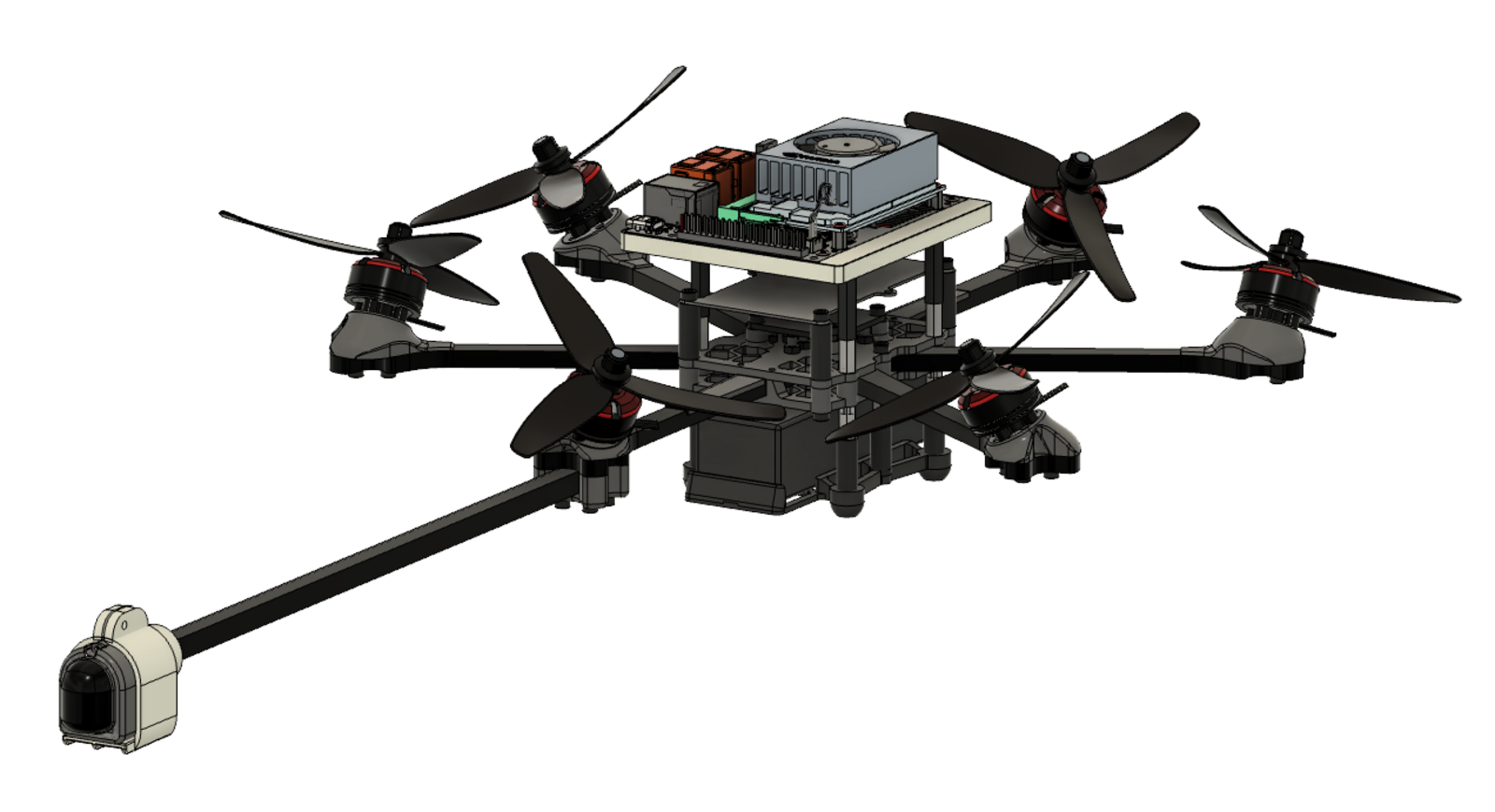
Enabling tactile interaction in the sky.

Volar Robotics builds aerial robots that don't just watch the world, they reach out and touch it. We give drones a true sense of touch, turning contact from an enemy into an ally: from a source of instability into reliable measurements that exploit it.

TRL 4–5 Sapienza DIAG spin-off Innovative start-up
From drone-as-a-camera to drone-as-a-worker: a new generation of aerial systems that don't just observe industrial assets: they touch them, measure them, and act on them.
$34.4B Inspection drone market by 2031, 16.8% CAGR
Any Material-agnostic by design: friction-based contact, no magnetic adhesion
0 Personnel at height: eliminate rope-access risk
No gimbals Fixed-pitch rotors, not tilting hardware: structurally lower cost

Technology

Two pillars. One physics-aware platform.

Our stack reframes aerial physical interaction: rather than fighting disturbances with brute actuation, we let physics do the stabilizing, and we give the robot a sense of touch so it knows exactly what physics will allow.

Friction anchor control

We treat the Coulomb friction cone as a passive, virtually‑infinite‑bandwidth physical regulator. High-frequency disturbances (gusts, prop-wash, surface texture) are rejected by physics itself. The active controller only has to maintain a slow safety margin inside the cone.

  • Stable contact with simple fixed-pitch multirotors
  • Robust against gusts and surface irregularities
  • Lower energy cost: longer missions per battery

Soft optical tactile sensing

A silicone membrane with an internal camera that "sees" what the robot touches. A learned regressor extracts contact-patch geometry and three-axis contact force at video rate, feeding the controller a live map of the contact state.

  • High-resolution contact force and geometry readout
  • Designed to flag incipient slip before contact is lost
  • Online friction estimation across substrates (in development)

Markets

Where contact-capable drones change the economics.

We focus on critical assets where inspection today means rope-access teams, scaffolding and plant shutdowns, and where a quantitative measurement is worth far more than an image.

Today · Touch & Sense

Oil & Gas / Offshore

Ultrasonic thickness measurements on platforms, refineries and storage tanks, without scaffolding, ATEX-aware, on demand.

Wind Energy

Tower and blade inspections on tall vertical infrastructure, with diagnostics that go beyond visual assessment.

Civil Infrastructure

Bridges, viaducts and stadia: frequent, repeatable inspections that turn condition monitoring into a routine, not an exception.

Tomorrow · Touch & Act → Grasp & Move

Mid-term

Light maintenance in flight

Cleaning remote sensors, applying protective coatings, installing IoT devices on vertical assets, operations that today demand rope teams or downtime.

Long-term

Cooperative aerial manipulation

Multi-agent aerial robots that grasp, transport and assemble in inaccessible environments, a new class of in-situ industrial work.

Why Volar

Designed for accessibility and frequent use.

By moving complexity from mechanics to software, our platform is dramatically simpler and more affordable than tilting-rotor systems, while doing things visual drones and magnetic crawlers cannot.

vs. Rope access

Zero personnel at height

Eliminate human risk, scaffolding cost and plant downtime.

vs. Visual drones

Quantitative diagnostics

Measure thickness and corrosion, not just photograph a surface.

vs. Tilting rotors

Software, not gimbals

Fixed-pitch hardware + advanced control = a fraction of the price.

vs. Magnetic crawlers

Any material, any geometry

Concrete, composite, aluminum, with continuous force adjustment.

Research

Research, told in chapters.

Each chapter is a stand-alone project that builds toward a single technical thesis. Open one for results, papers and code.

Team

Engineers and scientists from Sapienza DIAG.

Volar Robotics is co-founded by two control engineers trained in aerial physical interaction at the Robotics Laboratory of Sapienza University of Rome.

Simone Orelli

Co-founder · Physical Interaction

Designs the flight control laws that let a multirotor enter, hold and leave contact with the environment, with stability, robustness and energy efficiency as first-class goals.

PhD candidate, ABRO · DIAG · Sapienza University of Rome

Personal website

Antonio Rapuano

Co-founder · AI & Tactile Perception

Leads the AI pipeline that turns soft-tactile signals into real-time friction estimates and contact intelligence, closing the perception–control loop.

PhD candidate, ABRO · DIAG · Sapienza University of Rome

Personal website

Contact

Let's talk about your inspections.

If you operate critical industrial assets, or provide NDT services for those who do, we'd love to discuss how a contact-capable aerial platform fits your workflow. Pilot collaborations are open.