
Research · Chapter 01

SOAR-Touch

Soft Optical Aerial Robot — Touch

The perception–control foundations of tactile aerial physical interaction: soft optical tactile feedback into an energy-aware contact controller, carried from bench characterization through software- and hardware-in-the-loop validation to flight on a fully-actuated multirotor.

Flight-validated 2025–2026

Work

What was built.

Part I · Soft optical tactile sensing

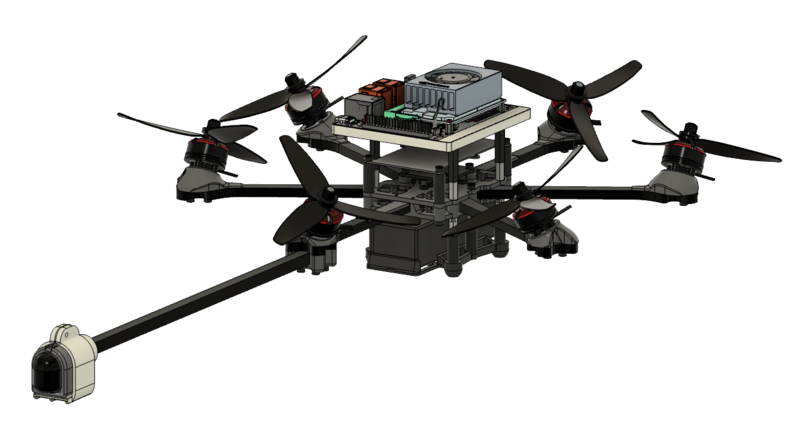
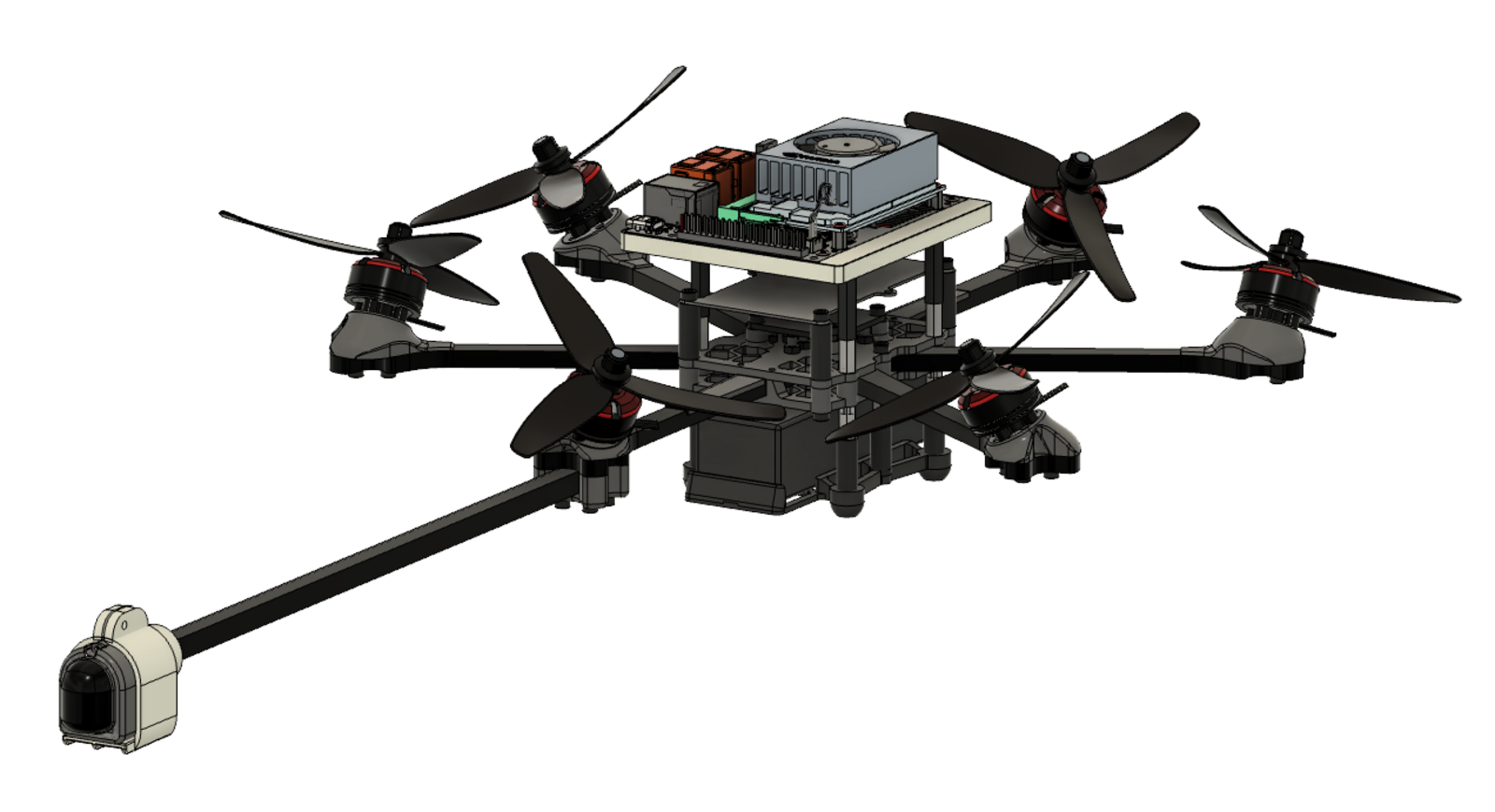
A complete tactile sensing pipeline that turns a silicone-membrane camera sensor into a quantitative contact-state observer. A purpose-built characterization rig on a UR10 manipulator at Sapienza DIAG produced the ground-truth dataset for a heteroscedastic deep regressor — itself trained against a physics-informed loss that anchors lateral force estimates to torque consistency. An Extended Kalman Filter fuses the regressor's per-sample uncertainty with the carrier's pose to produce stable estimates of contact patch geometry and contact force. The full pipeline was first validated in closed-loop force–motion control on the UR10, then deployed in flight on the UTwente miniThex hexarotor with both flat and tilted sensor-mount configurations.


Part II · SOT-aided aerial interaction

An energy-aware aerial interaction stack built on top of the tactile pipeline. A geometric SE(3) controller drives the multirotor's pose; a dual-channel admittance layer (contact-compliant in translation, stiff in rotation) shapes the contact wrench; an on-line manifold-aware reference generator solves a quadratic program on SO(3) at every cycle, exploiting the friction cone and surface reaction force to minimize rotor power while maintaining the hybrid force–motion reference. The full stack was validated in Simulink with stochastic wind and contact-model uncertainty, then in hardware-in-the-loop on a Franka Research 3 arm, then in free flight on the miniThex against both vertical and upward-tilted surfaces.

Team

The people behind SOAR-Touch.

Researchers

  • Simone Orelli · Volar Robotics — flight control & physical interaction
  • Antonio Rapuano · Volar Robotics — tactile perception & AI

Principal Investigator

  • Alessandro De Luca · Sapienza University of Rome · DIAG

Supervisors

  • Antonio Franchi · University of Twente · RaM
  • Barbara Bazzana · University of Twente · RaM
  • Andrea Cristofaro · Sapienza University of Rome · DIAG
  • Marilena Vendittelli · Sapienza University of Rome · DIAG

Timeline

From kick-off to flight.

  1. Aug 2025 · Start

    Project kick-off

  2. Oct 2025 · Simulation

    Proof of concept in simulated environment

    The full perception–control architecture first exercised in software, under stochastic wind and a virtual contact perception layer affected by uncertainty, establishing the energy-aware concept's feasibility before any hardware investment.

  3. Dec 2025 · Dataset

    Tactile dataset acquired

    A controlled six-phase contact protocol on a UR10 manipulator equipped with a force/torque sensor produces the labeled wrench–pose–image dataset that will ground the tactile inverse-model regressor.

  4. Dec 2025 · Perception

    First iteration of the tactile inverse model

    The heteroscedastic deep regressor is trained against a physics-informed loss, then demoed in closed-loop orientation-and-force regulation on the UR10 using the regressed tactile info.

  5. Mar 2026 · Deployment

    Full stack on a robot manipulator

    The first hardware-in-the-loop experience stressing the complete SOAR-Touch stack (tactile perception, admittance, and the energy-aware reference generator) exercised end-to-end on a Franka Research 3 manipulator.

  6. Apr 2026 · Aerial perception

    Tactile inference in flight

    The perception–control pipeline deployed onboard the miniThex hexarotor achieves real-time surface-pose estimation during flight, enabling simultaneous perpendicular alignment and contact force regulation with both a flat and a tilted sensor mount.

  7. Apr 2026 · Aerial deployment

    Full stack validated in flight

    The complete interaction control stack is engaged in-flight against vertical and upward-tilted surfaces, leveraging surface friction to enhance closed-loop stability and actively reduce the load borne by the actuators.

  8. Apr 2026 · End

    Project close

Media

Experiments on video.

Full-resolution recordings on Zenodo: DOI 10.5281/zenodo.20271808

Funding & acknowledgement

euROBIN.

euROBIN — The European Excellence Network on AI-Powered Robotics

SOAR-Touch was carried out within euROBIN, the European Network of Excellence in Robotics, co-funded by the European Union. The flight campaigns were hosted by the Robotics and Mechatronics group at the University of Twente.

← Back to Research